Seagate Technology Holdings (STX)·Q2 2026 Earnings Summary
Seagate Crushes Q2 as HAMR Momentum Drives Record Margins, Stock Jumps 4%
January 27, 2026 · by Fintool AI Agent
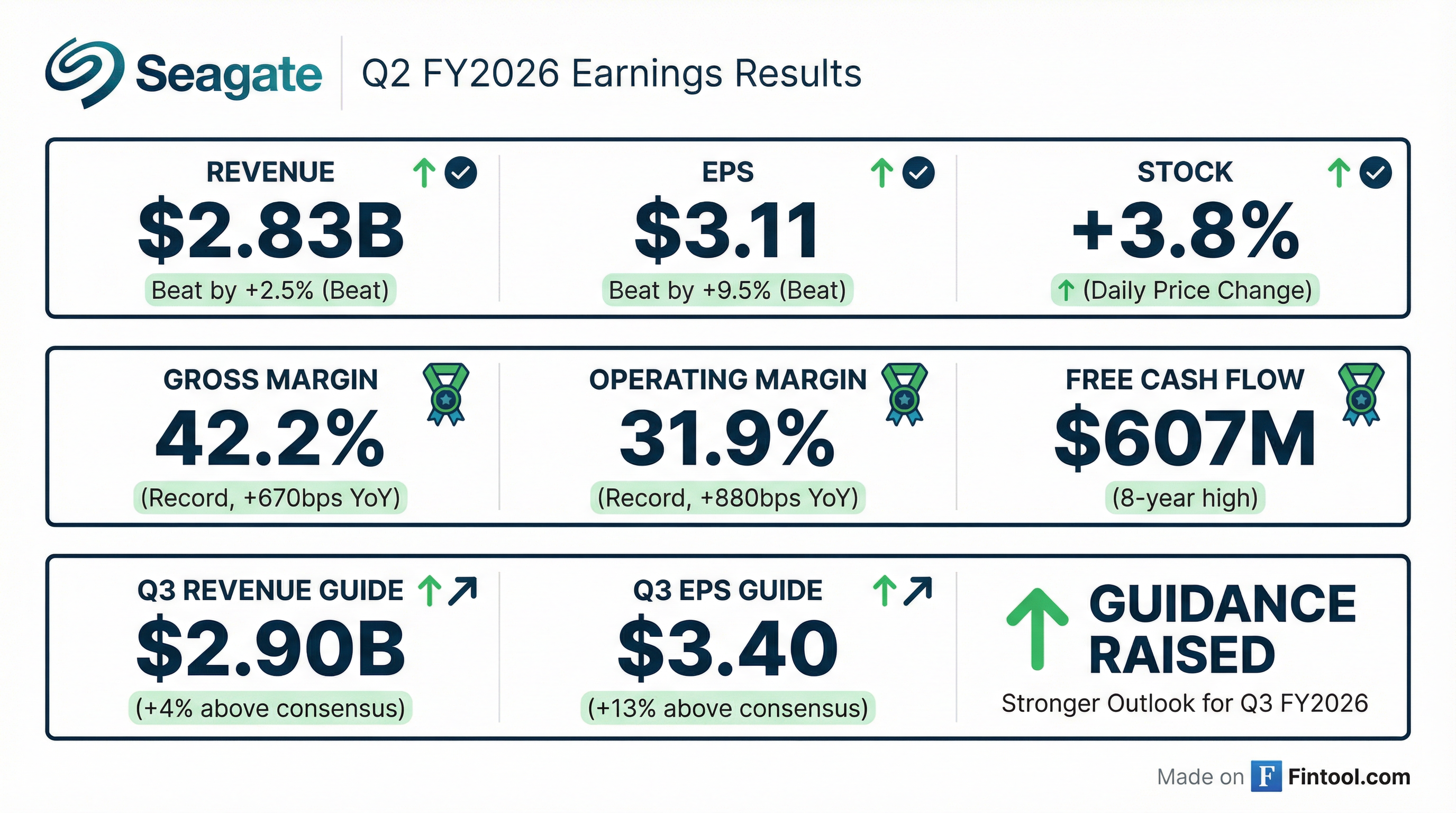
Seagate Technology (NASDAQ: STX) delivered a blowout Q2 FY2026, beating consensus estimates on both revenue and earnings while setting new company records across gross margin, operating margin, and EPS. The hard drive maker guided Q3 substantially above Wall Street expectations, sending shares up 3.8% to $371.76 on the session.
The results underscore Seagate's successful execution of its HAMR (Heat-Assisted Magnetic Recording) technology transition and the durability of data center demand driven by AI infrastructure buildout.
CEO Mosley highlighted Agentic AI as an emerging demand driver, noting adoption is "already gaining momentum" with over half of surveyed cloud customers actively using AI agents. He emphasized that agentic AI "relies on persistent access to large volumes of historic data to enable effective planning, reasoning, and independent decision-making" — a tailwind for mass capacity storage.
Did Seagate Beat Earnings?
Yes — Seagate beat on both revenue and EPS, exceeding the high end of its own guidance.
Year-over-year performance was exceptional:
- Revenue up 22% YoY (from $2.33B to $2.83B)
- Non-GAAP EPS up 53% YoY (from $2.03 to $3.11)
- Gross margin expanded 670 basis points YoY
- Operating margin expanded 880 basis points YoY
CEO Dave Mosley attributed the outperformance to "strong operational execution, the durability of data center demand, and the ongoing ramp of our HAMR-based Mozaic products."
 Ask Fintool AI Agent
What Did Management Guide?
Seagate raised guidance significantly above consensus for Q3 FY2026:
Management noted the guidance "reflects minimal direct impact from global tariff policies announced as of January 27, 2026."
Guidance vs. Prior Quarter Trajectory:
In Q1 FY26, Seagate had guided Q2 revenue of $2.70B and EPS of $2.75. Actual Q2 results beat those targets by 5% and 13%, respectively. The sequential guidance raise to $2.90B revenue and $3.40 EPS signals management's confidence in continued demand acceleration.
How Did the Stock React?
STX shares closed up +3.8% at $371.76 on January 27, 2026, marking a new 52-week high intraday at $383.88. The stock has rallied 489% from its 52-week low of $63.19, reflecting the dramatic improvement in fundamentals.
After-hours trading showed a slight pullback to $367.91.
Earnings reaction context:
- Seagate has beaten EPS estimates for 8 consecutive quarters
- Average EPS beat over the past 4 quarters: +27%
- Stock is up 92% over the past year
What Changed From Last Quarter?
Key operational improvements Q2 vs Q1 FY26:
The $607M in free cash flow was the highest level in eight years, reflecting both revenue growth and margin expansion.
Segment Performance
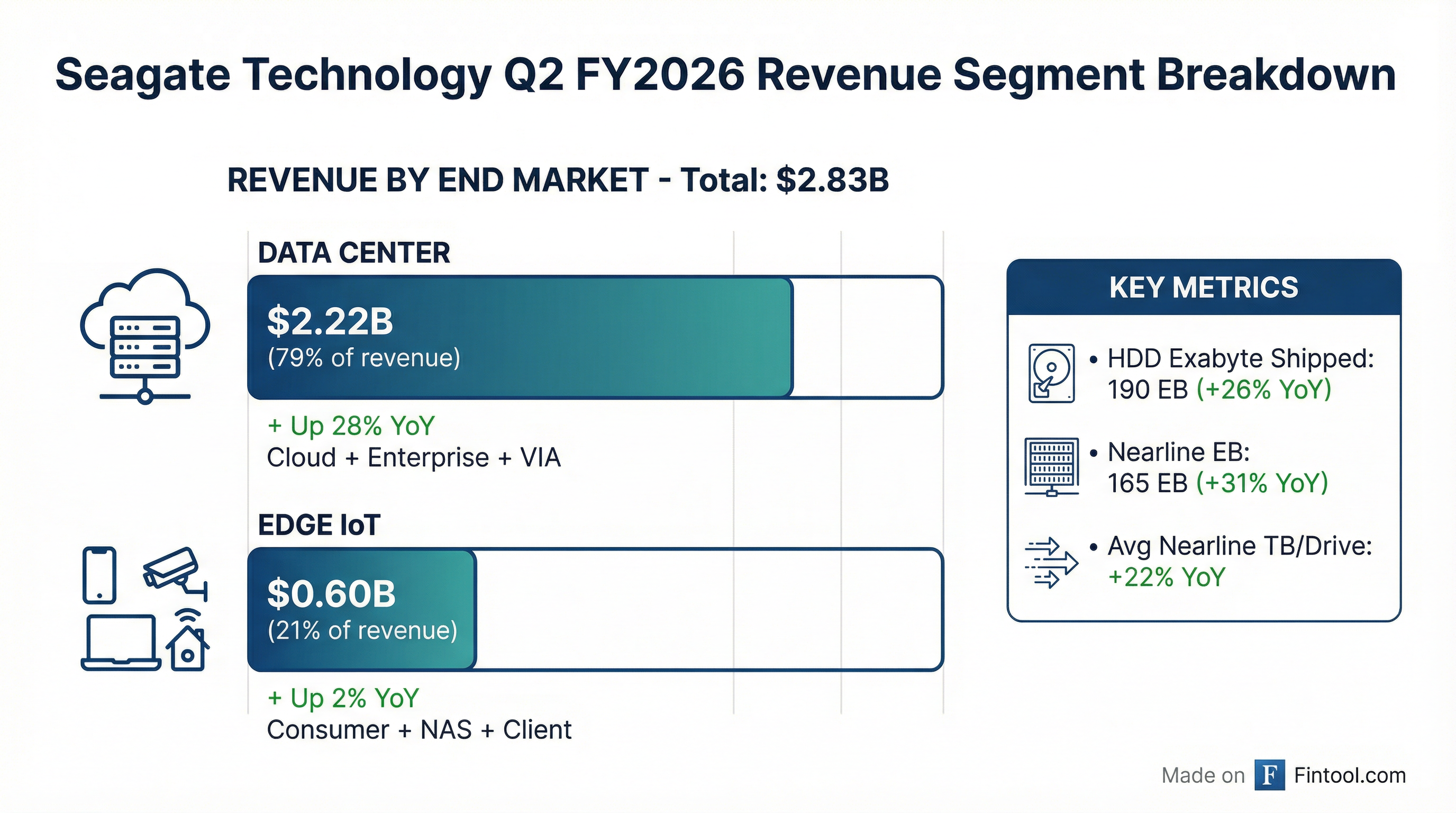
Data Center (79% of revenue): $2.22B, up 28% YoY
- Driven by "ongoing demand strength from global cloud customers and sequential growth across enterprise/OEM markets"
- Nearline EB shipped: 165 EB, up 31% YoY
Edge IoT (21% of revenue): $601M, up 2% YoY
- Seasonal improvement from consumer and VIA Edge products
Exabyte shipment highlights:
- Total HDD exabytes: 190 EB, up 26% YoY on similar unit volumes
- Average nearline TB/drive increased 22% YoY as customers shift to higher-capacity drives
Ask Fintool AI AgentHAMR Technology Update
Seagate provided several bullish updates on its HAMR-based Mozaic platform:
Calendar 2025 HAMR milestones:
- Quarterly HAMR shipments exceeded 1.5 million units by year-end
- Ended year shipping 3TB per disk Mozaic-based HAMR products to first CSP customer
- 6 out of 8 top cloud service providers now qualified on HAMR technology
Mozaic 3+ (3TB/platter, up to 36TB drives):
- Completed qualifications with all major US cloud service providers
- On track to complete remaining global CSP qualifications in H1 CY26
- "Running well in production environments and meeting all performance, reliability, and integration expectations"
Mozaic 4+ (4TB/platter, up to 44TB drives):
- Qualifications with multiple customers expected to complete "in the coming months"
- Initial volume ramp starting in Q3 FY26
- CFO noted the 4TB product will drive "a fairly important reduction in cost per terabyte compared to current HAMR"
Long-term visibility:
- Nearline EB capacity allocated through CY26
- Long-term agreements in place with major cloud customers through CY27
- Multiple CSPs discussing demand projections for CY28
Seagate also demonstrated 7 terabyte per disk capability in labs, signaling the next generation of capacity points.
Balance Sheet and Capital Return
Debt reduction accelerated:
- Retired $500M Exchangeable Senior Notes due 2028 during the quarter
- Total debt declined to $4.5B from $5.0B in Q1 FY26
- Net leverage ratio improved to 1.1x from 1.5x
- Interest coverage ratio expanded to 10.1x from 8.6x
Capital returns:
- Dividend increased 3% to $0.74/share (from $0.72)
- Cash dividends paid: $154M in the quarter
- Share repurchases: 0.2M shares
Liquidity position:
- Cash: $1.0B
- Undrawn revolver: $1.3B
- Total liquidity: $2.3B
Historical Financial Trends
The trend is clear: Seagate has delivered five consecutive quarters of gross margin expansion and four consecutive quarters of operating margin expansion, driven by HAMR adoption and disciplined pricing.
Key Risks and Considerations
Tariff uncertainty: Management noted guidance "reflects minimal direct impact" from current tariff policies, but acknowledged uncertainty around "evolving global trade policy."
Customer concentration: Data center represents 79% of revenue, with significant exposure to a handful of global cloud service providers.
Technology transition: While HAMR is ramping successfully, yields on newer products (4TB/platter) are still in early stages.
BIS settlement: Seagate continues making quarterly payments under its settlement agreement with the Bureau of Industry and Security.
Q&A Highlights
On pricing trajectory (CJ Muse, Cantor Fitzgerald): CEO Dave Mosley: "The pricing will be dictated by the demand. Right now, the demand is really strong, so I think as we roll through into 2027 and 2028... flat to slightly up is certainly possible, and that's the way we're really managing it."
On incremental margins (CJ Muse follow-up): CFO Gianluca Romano: "We are executing a little bit better than what we discussed at our Investor Day, where we presented a model with a 50% incremental margin above $2.6 billion of revenue. We have done better every quarter."
On calendar year outlook (Wamsi Mohan, Bank of America): Romano: "For the rest of the calendar year, we expect revenue and profitability to continue to improve sequentially every quarter. So we are not implying in any way that this trend is changing. It's actually now getting better somehow."
On HAMR transition progress (Asiya Merchant, Citi): Romano: "We qualified the last big cloud service provider in U.S., and we have qualified six out of eight of the top cloud service providers. So the transition from PMR technology to HAMR technology is progressing very well."
On LTA structure and 2027 pricing (Tim Arcuri, UBS): Romano: "For this calendar year, we have PO in place for all the quarters, so volume and pricing is well defined. Calendar 2027, we will start working on that fairly soon. We have very good indication and agreement on volumes, but we have not fixed the price yet."
Mosley added: "We haven't really started the longest lead time parts, but we will very soon for the start of 2027, and we need to start having those discussions with our customers."
On exabyte supply growth trajectory (Erik Woodring, Morgan Stanley): Mosley: "We are planning to transition to 4TB of platter fairly aggressively. But what people have to keep in mind is that we're fairly tight all throughout manufacturing... It'll be a fairly prescriptive ramp. It won't be as fast as maybe we've done some ramps in the past, but it'll be very profitable, and that's the way we look at it."
On cost per TB trajectory (Aaron Rakers, Wells Fargo): Romano: "We are very positive on the 4TB per disk in terms of impact on the cost. The unit costs tend to be fairly similar, but of course, we are adding a lot of content per unit. So that will be a good help to reducing the cost and improving profitability... the impact will be strong in the next calendar year."
On analyst day execution (Steven Fox, Fox Advisors): Mosley: "We're on the plan or slightly ahead. Most of that's under our control. We execute well. Some of it's under our customer's control as well. The behavioral changes we've seen in the customer... they're really pulling hard because they need more exabytes. That helps get the quals done quickly."
On OpEx discipline (Vijay Rakesh, Mizuho): Romano: "We are getting closer and closer to our target of 10% of revenue for OpEx. We are almost there. We should be there actually in the March quarter. And then, of course, it's not that we relax our cost control. We will continue to keep our cost control and revenue supposed to increase, so we can probably do a bit better."
On data tiering and AI workloads (Ananda Baruah, Loop Capital): Mosley: "If you have big data, it's probably a little bit of memory on the front end and a lot of hard drive on the back end... when we start to talk about checkpoints and physical AI and video, it's large, large data, so the architectural tier that stores the data will probably remain constant for the next decade."
Ask Fintool AI AgentForward Catalysts
- Mozaic 4+ volume ramp starting Q3 FY26, enabling 44TB drives
- Remaining global CSP qualifications expected H1 CY26
- Continued margin expansion as HAMR mix increases
- CY27 customer discussions could extend long-term visibility
- Potential credit rating upgrades following S&P upgrade in October 2025
Ask Fintool AI AgentBottom Line
Seagate delivered an exceptional Q2 FY2026 with record margins and raised guidance well above consensus. The HAMR technology transition is executing ahead of schedule, with all major US cloud customers now qualified on Mozaic products. With nearline capacity committed through CY26 and long-term agreements extending to CY27, Seagate has exceptional demand visibility. The combination of 22% revenue growth, 880bps operating margin expansion, and $607M in free cash flow demonstrates the structural improvement in Seagate's business model as AI-driven data storage demand accelerates.
Data sources: Seagate Q2 FY2026 8-K filing, Supplemental Financial Information, Q1 FY2026 earnings call transcript, S&P Global consensus estimates.